Women, literature, and the domesticated landscape : England's disciples of flora, 1780-1870 /
"Combining an analysis of literature and art, this book contends that the 'domesticated landscape' is key to understanding women's complex negotiation of private and public life in a period of revolution and transition. As more women became engaged in horticultural and botanical...
| Main Authors: | , |
|---|---|
| Format: | Book |
| Language: | English |
| Published: |
Cambridge :
Cambridge University Press,
2011.
|
| Series: | Cambridge studies in nineteenth-century literature and culture ;
76. |
| Subjects: | |
| Online Access: | Table of contents Contributor biographical information Cover image Publisher description |
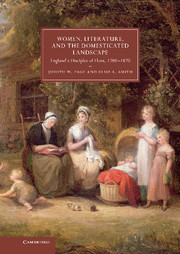
| Summary: | "Combining an analysis of literature and art, this book contends that the 'domesticated landscape' is key to understanding women's complex negotiation of private and public life in a period of revolution and transition. As more women became engaged in horticultural and botanical pursuits, the meaning of gardens - recognized here both as sites of pleasure and labor, and as conceptual and symbolic spaces - became more complex. Women writers and artists often used gardens to educate their readers, to enter into political and cultural debates, and to signal moments of intellectual and spiritual insight. Gardens functioned as a protected vantage point for women, providing them with a new language and authority to negotiate between domestic space and the larger world. Although this more expansive form of domesticity still highlighted the virtues associated with the feminized home, it also promised a wider field of action, re-centering domesticity outward"-- |
|---|---|
| Physical Description: | xvii, 314 pages : illustrations ; 26 cm. |
| Bibliography: | Includes bibliographical references (pages 288-307) and index. |
| ISBN: | 9780521768658 0521768659 |