Theorising the responsibility to protect /
"One of the most important developments in world politics in the last decade has been the spread of the idea that state sovereignty comes with responsibilities as well as privileges, and that there exists a global responsibility to protect people threatened by mass atrocities. The principle of...
| Other Authors: | , |
|---|---|
| Format: | Book |
| Language: | English |
| Published: |
Cambridge, United Kingdom ; New York :
Cambridge University Press,
2015.
|
| Subjects: | |
| Online Access: | Cover image |
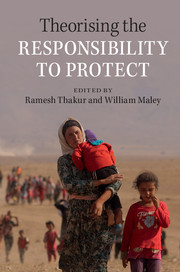
| Summary: | "One of the most important developments in world politics in the last decade has been the spread of the idea that state sovereignty comes with responsibilities as well as privileges, and that there exists a global responsibility to protect people threatened by mass atrocities. The principle of the Responsibility to Protect is an acknowledgment by all who live in zones of safety of a duty of care towards those in zones of danger. Thakur and Maley argue that this principle has not been discussed sufficiently in the context of international and political theory, in particular the nature and foundations of political and international order and the strength and legitimacy of the state. The book brings together a range of authors to discuss the different ways in which the Responsibility to Protect can be theorised, using case studies to locate the idea within wider traditions of moral responsibilities in international relations"-- "One of the most important developments in world politics in the last decade has been the spread of the twin ideas that state sovereignty comes with responsibilities - both domestic and international - as well as privileges, and that there exists a global responsibility to protect people threatened by mass-atrocity crimes. The 2001 report of the International Commission on Intervention and State Sovereignty entitled The Responsibility to Protect put these ideas into active circulation, and United Nations resolutions in 2005 on the 60th anniversary of the establishment of the United Nations gave the idea further substance. More recently, the justification of NATO action in Libya on the strength of Security Council Resolutions 1970 and 1973, which made explicit reference to the principle of the Responsibility to Protect, has put this particular notion at the centre of discussion of some of the most challenging political dilemmas of our times. As international leaders struggle to find ways to deal with mounting political violence in Syria and more recently with the emergence of the self-styled 'Islamic State in Iraq and Syria', the idea of the Responsibility to Protect, now increasingly labelled simply R2P, is never far below the surface"-- |
|---|---|
| Physical Description: | x, 344 pages ; 24 cm |
| Bibliography: | Includes bibliographical references and index. |
| ISBN: | 9781107041073 (hardback) 1107041074 (hardback) 9781107621947 (paperback) 1107621941 (paperback) |