The Cambridge handbook of psycholinguistics /
Our ability to speak, write, understand speech and read is critical to our ability to function in today's society. As such, psycholinguistics, or the study of how humans learn and use language, is a central topic in cognitive science. This comprehensive handbook is a collection of chapters writ...
| Other Authors: | , , |
|---|---|
| Format: | Book |
| Language: | English |
| Published: |
Cambridge ; New York :
Cambridge University Press,
2012.
|
| Series: | Cambridge handbooks in psychology.
|
| Subjects: | |
| Online Access: | Cover image Contributor biographical information Publisher description Table of contents only |
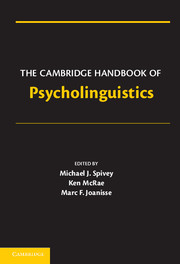
Table of Contents:
- Part I. Speech Perception: 1. Speech perception Carol Fowler and James Magnuson; 2. Neural bases of speech perception
- phonology, streams and auditory word forms Sophie Scott; 3. Learning the sounds of language Jenny Saffran and Sarah Sahni; Part II. Spoken Word Recognition: 4. Current directions in research in spoken word recognition Arthur Samuel and Meghan Sumner; 5. Computational models of spoken word recognition James Magnuson, Daniel Mirman and Harlan Harris; 6. Finding the words: how young children develop skill in interpreting spoken language Anne Fernald and Michael Frank; 7. Event-related potentials and magnetic fields associated with components and subcomponents that enable spoken word recognition John Connolly, Randy Newman and Kelly Forbes; Part III. Written Word Recognition: 8. Visual word recognition in skilled adult readers Michael Cortese and David Balota; 9. Computational models of reading: connectionist and dual-route approaches Mark Seidenberg; 10. Decoding, orthographic learning and the development of visual word recognition Kate Nation; 11. How does the brain read words? Rebecca Sandak, Stephen Frost, Jay Rueckl, Nicole Landi, w. Einar Mencl, Leonard Katz and Kenneth Pugh; Part IV. Semantic Memory: 12. The human conceptual system Lawrence Barsalou; 13. Computational models of semantic memory George Cree and Blair Armstrong; 14. Developing categories and concepts Linda Smith and Eliana Colunga; Part V. Morphological Processing: 15. Derivational morphology and skilled reading: an empirical overview Kevin Diependaele, Jonathan Grainger and Dominiek Sandra; 16. The neural basis of morphology: a tale of two mechanisms? Anna Woollams and Karalyn Patterson; Part VI. Sentence Comprehension: 17. Individual differences in sentence processing Thomas Farmer, Jennifer Misyak and Morten Christiansen; 18. The neurobiology of sentence comprehension Lee Osterhout, Albert Kim and Gina Kuperberg; 19. Computational and corpus models of human sentence comprehension Douglas Roland and Mary Hare; Part VII. Sentence Production: 20. Research in language production Zenzi Griffin and Christopher Crew; 21. Language production: computational models Gary Dell and Joana Cholin; 22. Language production: patient and imaging research Gabriella Vigliocco, Daniel Tranel, and Judit Druks; Part VIII. Figurative Language: 23. Figurative language: normal adult cognitive research Raymond Gibbs, Jr., Nicole Wilson and Gregory Bryant; 24. Computational approaches to figurative language Birte Loenneker-Rodman and Srini Narayanan; 25. The development of figurative language Cristina Cacciari and Roberto Padovani; 26. Cognitive neuroscience of figurative language Seana Coulson; Part IX. Discourse and Conversation: 27. Spoken discourse and its emergence Herbert Clark; 28. Computational modeling of discourse and conversation Arthur Graesser, Danielle Macnamara and Vasile Rus; 29. Children, conversation, and acquisition Eve V. Clark; 30. The electrophysiology of discourse and conversation Jos Van Berkum; Part X. Language and Thought: 31. How the languages we speak shape the ways we think: the FAQs Lera Boroditsky; 32. Computational approaches to language and thought Terry Regier; 33. Language and cognition in development Dedre Gentner and Stella Christie; 34. Language, thought and... brain? Monica Gonzalez-Marquez.